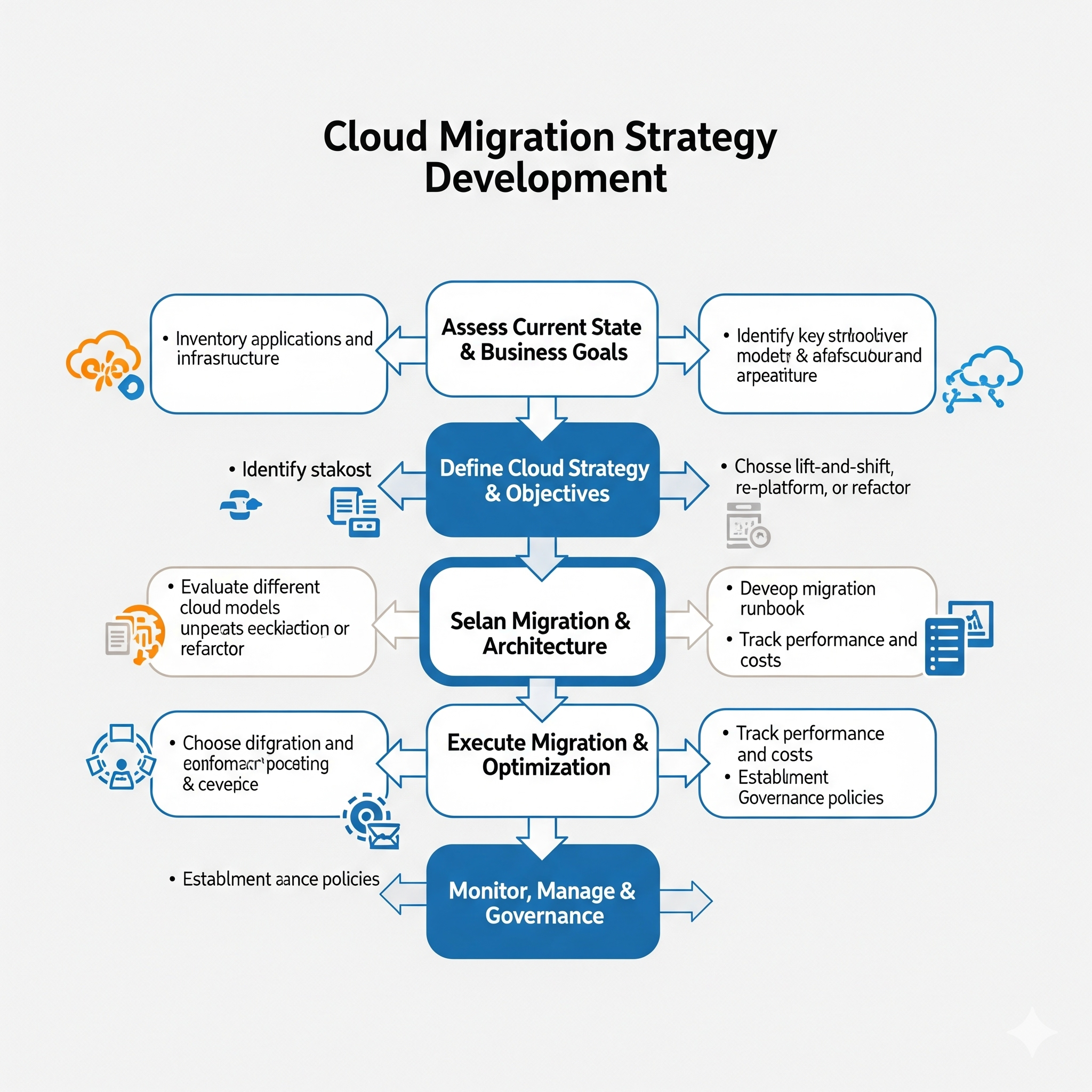
A cloud migration startegy is extra than simply transferring workloads from on-premises servers to the cloud. It is set aligning cloud adoption with commercial enterprise targets, ensuring protection, scalability, and lengthy-time period value. Developing a dependent method minimizes chance, optimizes charges, and ensures that the cloud transformation delivers measurable benefits.
In this text, we outline a step-by way of-step manual to constructing a cloud migration strategy, addressing not unusual demanding situations, and offering an in depth roadmap that groups can observe.
Set Clear Goals and Objectives
Every a success cloud migration begins with well-defined desires. Without clarity, tasks danger going over budget or failing to satisfy expectations.
Align with Business Goals: Identify how cloud migration will assist strategic objectives. Examples encompass reducing IT prices, improving client experience, permitting quicker product improvement, or improving machine performance.
Build a Business Case: Conduct a Total Cost of Ownership (TCO) contrast to evaluate current infrastructure charges as opposed to projected cloud prices. Consider savings from reduced hardware protection, optimized useful resource usage, and bendy scaling.
Define Success Metrics: Establish measurable KPIs along with system uptime, software performance, cost discount targets, and scalability benchmarks.
Assess the Current IT Environment
A detailed infrastructure and application assessment is crucial earlier than migrating workloads.
- Inventory IT Assets: Create a complete list of programs, databases, servers, and dependencies.
- Evaluate Performance Metrics: Understand which packages are project-essential and examine workload needs.
- Identify Risks and Dependencies: Applications with high interdependencies may additionally require more cautious making plans. Legacy structures may also need refactoring or replacement.
- Evaluate Security and Compliance: Determine existing vulnerabilities and ensure compliance with rules inclusive of GDPR, HIPAA, or PCI DSS.
Plan the Cloud Migration Strategy
This stage involves designing the roadmap, cloud architecture, and migration approach.
Choose the Right Cloud Model
- Public Cloud: Best for scalability, flexibility, and cost efficiency.
- Private Cloud: Ideal for companies requiring excessive safety and manage.
- Hybrid Cloud: Combines both for stability and versatility.
- Multi-Cloud: Utilizes services from a couple of providers for resilience and fee optimization.
Select a Cloud Provider
Evaluate companies like AWS, Microsoft Azure, and Google Cloud based totally on:
- Pricing models and price predictability.
- Security functions and compliance certifications.
- Global statistics middle availability.
- Ecosystem and integration with existing equipment.
Prioritize Applications Using the 6 R’s Framework
- Rehosting (Lift and Shift): Moving packages without modifications.
- Replatforming: Making small changes to optimize for cloud.
- Repurchasing: Replacing applications with SaaS solutions.
- Refactoring: Re-architecting apps to leverage cloud-native features.
- Retiring: Eliminating old or redundant apps.
- Retaining: Keeping certain structures on-premises for compliance or overall performance motives.
Design Your Cloud Architecture
Build a scalable, stable, and resilient architecture that aligns with performance wishes, catastrophe healing objectives, and future boom.
Address Security and Compliance
Security is one of the maximum crucial factors of cloud migration making plans.
Data Protection: Encrypt information each at relaxation and in transit.
Identity and Access Management (IAM): Implement strong authentication and least-privilege get entry to controls.
Network Security: Utilize firewalls, intrusion detection structures, and VPNs.
Compliance Alignment: Ensure the migration plan aligns with enterprise-particular regulations including ISO 27001, HIPAA, or GDPR.
Prepare and Train Your Team
The achievement of a migration relies upon at the readiness of the workforce.
Upskilling: Provide training on cloud systems, DevOps practices, and automation gear.
Cloud Governance Policies: Establish guidelines for fee control, resource usage, and get entry to manipulate.
Culture of Adaptation: Encourage groups to embrace innovation and non-stop improvement.
Execute the Migration
A phased technique ensures minimal disruption and controlled chance.
Testing Environment: Validate workloads in a staging surroundings to assess compatibility, performance, and protection.
Phased Migration: Start with non-critical workloads before transferring center commercial enterprise systems.
Data Transfer Strategy: Use migration equipment furnished through cloud companies (e.G., AWS Snowball, Azure Migrate, Google Transfer Appliance).
Monitor and Troubleshoot: Track performance metrics in actual-time to solve problems promptly.
Post-Migration Optimization and Governance
Once migration is complete, continuous optimization ensures long-term success.
Performance Monitoring: Use cloud-native tools like AWS CloudWatch, Azure Monitor, or Google Operations Suite.
Cost Management: Implement cost optimization practices such as auto-scaling, rightsizing resources, and reserved instances.
Disaster Recovery: Develop backup and failover strategies to ensure business continuity.
Ongoing Governance: Establish clear policies for data management, compliance, and security audits.
Cloud Migration Roadmap: The Four Phases
A usual cloud migration roadmap may be broken down into four ranges:
Planning and Goal Setting – Define targets, evaluate TCO, and build a enterprise case.
Assessment and Preparation – Audit contemporary structures, discover dependencies, and examine dangers.
Execution and Migration – Move workloads the use of phased strategies and take a look at thoroughly.
Optimization and Governance – Monitor, steady, and refine cloud operations.
Cloud Migration Checklist
Before executing migration, corporations ought to make sure:
- Goals and business case defined.
- Inventory of belongings and dependencies complete.
- Cloud issuer and model selected.
- Security and compliance plan in location.
- Migration technique defined (Rehost, Refactor, etc.).
- Team educated and equipped.
- Testing surroundings organized.
- Governance and monitoring strategy mounted.
Common Cloud Migration Challenges
- Downtime and Disruption: Mitigated with the aid of phased migration.
- Data Security Risks: Addressed by encryption and IAM.
- Cost Overruns: Controlled through designated making plans and monitoring.
- Skill Gaps: Resolved with the aid of team of workers schooling and hiring cloud specialists.
- Compliance Issues: Managed with early audits and issuer certifications.
Conclusion
A complete cloud migration startegy requires careful planning, robust governance, and alignment with commercial enterprise dreams. By putting clean targets, assessing contemporary infrastructure, deciding on the right cloud version, and executing in a phased way, corporations can make certain a easy transition. Post-migration optimization and governance make sure that the cloud environment maintains to supply scalability, value-efficiency, and safety.
More Information about cloud migration startegy!