Introduction
Information Technology (IT) has advanced from being a supportive feature to turning into the backbone of modern businesses. In these days’s enormously competitive and digitized international, IT is not non-compulsory—it is fundamental to survival and increase. From improving purchaser engagement to permitting seamless collaboration and information-driven decision-making, IT serves as both a motive force of innovation and a defend in opposition to disruption.
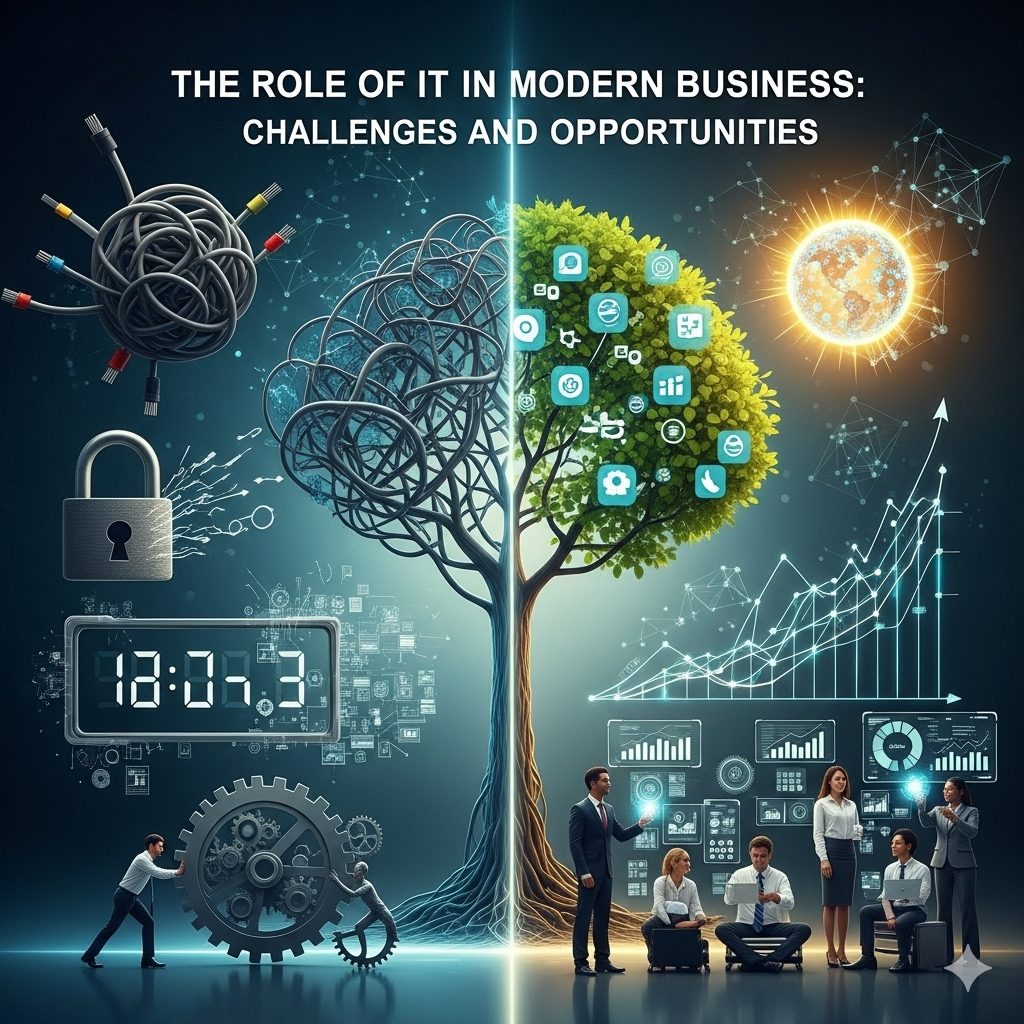
However, with these possibilities come challenges. Businesses ought to address rising cybersecurity threats, excessive fees of infrastructure, and the steady strain to evolve to rapid technological improvements. The ability to strategically align IT with business goals and maintain ethical records governance determines whether corporations prevail or fall in the back of.
This article explores the role of IT in modern-day enterprise, outlining each the possibilities it creates and the challenges it poses, at the same time as addressing vital questions about the impact of records structures on business operations.
The Role of IT in Modern Business
1. Enhanced Customer Engagement
Modern companies use IT to construct deeper relationships with customers. From patron courting management (CRM) software to AI-powered chatbots, corporations can now offer personalized stories at scale. Data analytics allows businesses recognize purchaser preferences, expect needs, and deliver tailored gives, ensuring more potent loyalty and pride.
2. Increasing Business Efficiency
Automation and technique digitization have converted how organizations function. Repetitive tasks may be treated by software, whilst workflow control structures streamline operations across departments. This no longer only reduces human errors but additionally frees up assets for strategic and innovative work.
3. Analytics and Data-Driven Insights
Information structures permit agencies to accumulate and analyze big amounts of facts. By leveraging predictive analytics and real-time reporting, agencies could make smarter selections, identify new market possibilities, and enhance hazard management.
4. Cybersecurity and Protection
As businesses depend closely on digital structures, IT plays a crucial role in safeguarding important statistics. Firewalls, encryption, intrusion detection, and compliance tools are essential to protect towards cyberattacks and facts breaches. Cybersecurity is not just an IT function it’s a boardroom priority.
5. Enhanced Communication and Collaboration
Globalization has made distributed teams common. With tools together with cloud-primarily based collaboration structures, video conferencing, and mission management software, IT guarantees seamless verbal exchange and expertise sharing, regardless of geographical boundaries.
6. Cloud Computing for Flexibility and Growth
Cloud answers offer scalable infrastructure, allowing corporations to enlarge without the load of physical IT investments. Companies can deploy programs faster, manipulate resources more efficiently, and reply speedy to changing market conditions.
7. Fostering Innovation
IT empowers businesses to experiment with new models, products, and services. Artificial intelligence (AI), Internet of Things (IoT), and blockchain are just a few technologies that allow companies to innovate and remain competitive in an evolving marketplace.
8. Gaining Competitive Advantage
By leveraging IT strategically, businesses can outperform competitors. Companies that adopt digital transformation early often gain faster market entry, stronger customer loyalty, and more efficient operations.
Opportunities IT Brings to Businesses
-
Enhanced Efficiency and Productivity
-
Automation eliminates repetitive tasks.
-
Advanced tools streamline workflows.
-
Productivity rises as employees focus on high-value tasks.
-
-
Innovation and Competitiveness
-
IT enables new product development.
-
Businesses can explore fresh revenue models.
-
Innovation creates differentiation in crowded markets.
-
-
Expanded Market Reach and Growth
-
Digital platforms open access to global audiences.
-
Online marketing and e-commerce remove geographical limits.
-
Businesses can scale faster with minimal infrastructure costs.
-
-
Improved Supply Chain Management
-
IT systems optimize logistics and inventory.
-
Demand forecasting reduces waste.
-
Real-time monitoring improves delivery reliability.
-
-
Collaboration and Communication
-
Teams in different locations can work seamlessly.
-
Knowledge sharing is faster and more effective.
-
Remote work becomes practical and efficient.
-
Challenges of IT in Modern Business
Cybersecurity and Data Protection
Businesses face constant threats from hackers, phishing, and ransomware. Protecting sensitive customer and company data requires continuous investment in advanced security systems and compliance with regulations such as GDPR or HIPAA.
High Investment Costs
Building IT infrastructure requires significant upfront spending. Hardware, software, licenses, and employee training can burden smaller companies. While long-term benefits are significant, the initial costs remain a challenge.
Rapid Technological Change
Technology evolves quickly, making systems obsolete in a short time. Businesses must continuously upgrade their tools, retrain staff, and adapt processes to remain competitive.
Strategic Alignment
IT initiatives often fail if not aligned with overall business goals. Without a clear strategy, investments may not yield measurable returns, leading to wasted resources.
Ethics and Data Governance
As companies collect vast amounts of personal data, ethical issues arise. Proper governance policies are essential to ensure transparency, fairness, and compliance with privacy laws.
Frequently Asked Questions
What is the role of IT in modern business?
IT plays a transformative role by enhancing efficiency, enabling innovation, improving communication, and safeguarding data. It drives growth and ensures that businesses can compete effectively in a digital-first world.
What is the role of information systems in modern businesses?
Information systems collect, process, and analyze data to support decision-making, streamline operations, and improve customer experiences. They also strengthen supply chain management and enable collaboration.
How does technology impact modern businesses?
Technology impacts businesses by automating processes, reducing costs, improving productivity, enabling remote work, and opening global market opportunities. It also helps companies adapt to customer needs faster.
What are the challenges of information systems in business?
The main challenges include cybersecurity threats, high IT costs, rapid changes in technology, lack of alignment with business goals, and ethical concerns related to data privacy.
Conclusion
The position of IT in contemporary business is each massive and fundamental. It enhances efficiency, fosters innovation, and allows organizations to expand into new markets. At the same time, it affords challenges inside the shape of cybersecurity risks, excessive investment necessities, and the complexity of maintaining up with technological evolution.
Businesses that be successful within the digital age are people who strategically align IT with their desires, invest wisely in infrastructure, and adopt sturdy governance for records ethics. IT isn’t only a device it’s miles the foundation of present day competitiveness.
By embracing generation at the same time as managing its risks, agencies can unlock new degrees of increase, resilience, and purchaser delight, making sure their relevance in an ever-converting international economy.
For More information about Role of IT in Modern Business!