Understanding IT Management
IT management refers to the practice of administering and controlling an organization’s technology resources. This includes hardware, software, data, networks, and human capital dedicated to information systems. The objective is to ensure that IT supports business goals effectively, enhances operational efficiency, and secures sensitive information.
In modern enterprises, IT management goes beyond maintaining servers and updating systems. It involves strategic planning, risk mitigation, digital transformation, and governance frameworks that allow businesses to remain competitive in a rapidly evolving digital economy.
Top IT Management Best Practices for 2025
1. Align IT Strategy with Business Objectives
In 2025, successful IT management requires a strong alignment between technology investments and business strategy. Leaders must ensure every IT initiative directly contributes to organizational growth, revenue optimization, and customer satisfaction.
2. Adopt Cloud-Native and Hybrid Solutions
Cloud computing continues to dominate IT infrastructure. Businesses are embracing hybrid models that integrate on-premises systems with public and private clouds. This approach delivers scalability, flexibility, and cost-efficiency, allowing companies to optimize workloads.
3. Strengthen Cybersecurity with Zero Trust
As cyberattacks grow more sophisticated, adopting a Zero Trust architecture has become essential. This model assumes no user or device is trustworthy by default, requiring continuous authentication and real-time monitoring to safeguard sensitive systems.
4. Invest in Automation and AI-Driven IT Operations (AIOps)
Automation is streamlining IT tasks such as system monitoring, troubleshooting, and patch management. With AIOps platforms, organizations can leverage machine learning to predict outages, detect anomalies, and accelerate response times.
5. Enhance IT Service Management (ITSM)
Implementing ITIL-based IT service management ensures that technology departments consistently deliver value. Incident management, SLA monitoring, and help desk optimization remain critical to enhancing user experience in 2025.
6. Prioritize Sustainability in IT
Green IT initiatives are gaining momentum. Organizations are adopting energy-efficient data centers, e-waste recycling programs, and sustainable procurement policies to reduce their environmental impact.
How to Build an Effective IT Governance Framework
An IT governance framework ensures accountability, transparency, and alignment of IT resources with business objectives. To build an effective framework, organizations must focus on the following elements:
1. Define Clear Objectives and Policies
Establish governance policies that outline IT decision-making authority, accountability, and performance expectations. Every IT investment should tie back to measurable business outcomes.
2. Implement Risk Management Protocols
An effective governance framework must address cybersecurity risks, compliance requirements, and disaster recovery plans. Risk assessments should be continuous and proactive.
3. Establish Key Performance Indicators (KPIs)
KPIs such as system uptime, incident resolution time, and cost-per-user metrics provide insights into IT effectiveness and help refine governance practices.
4. Adopt Standardized Frameworks
Frameworks like COBIT, ITIL, and ISO/IEC 38500 provide structured methodologies for governance. Combining these with organizational needs ensures consistency and compliance.
5. Foster Collaboration Across Departments
IT governance is not just the responsibility of IT teams. It requires collaboration between executives, department heads, compliance officers, and IT professionals to achieve long-term success.
ITIL vs COBIT vs DevOps: Which Framework Should You Use?
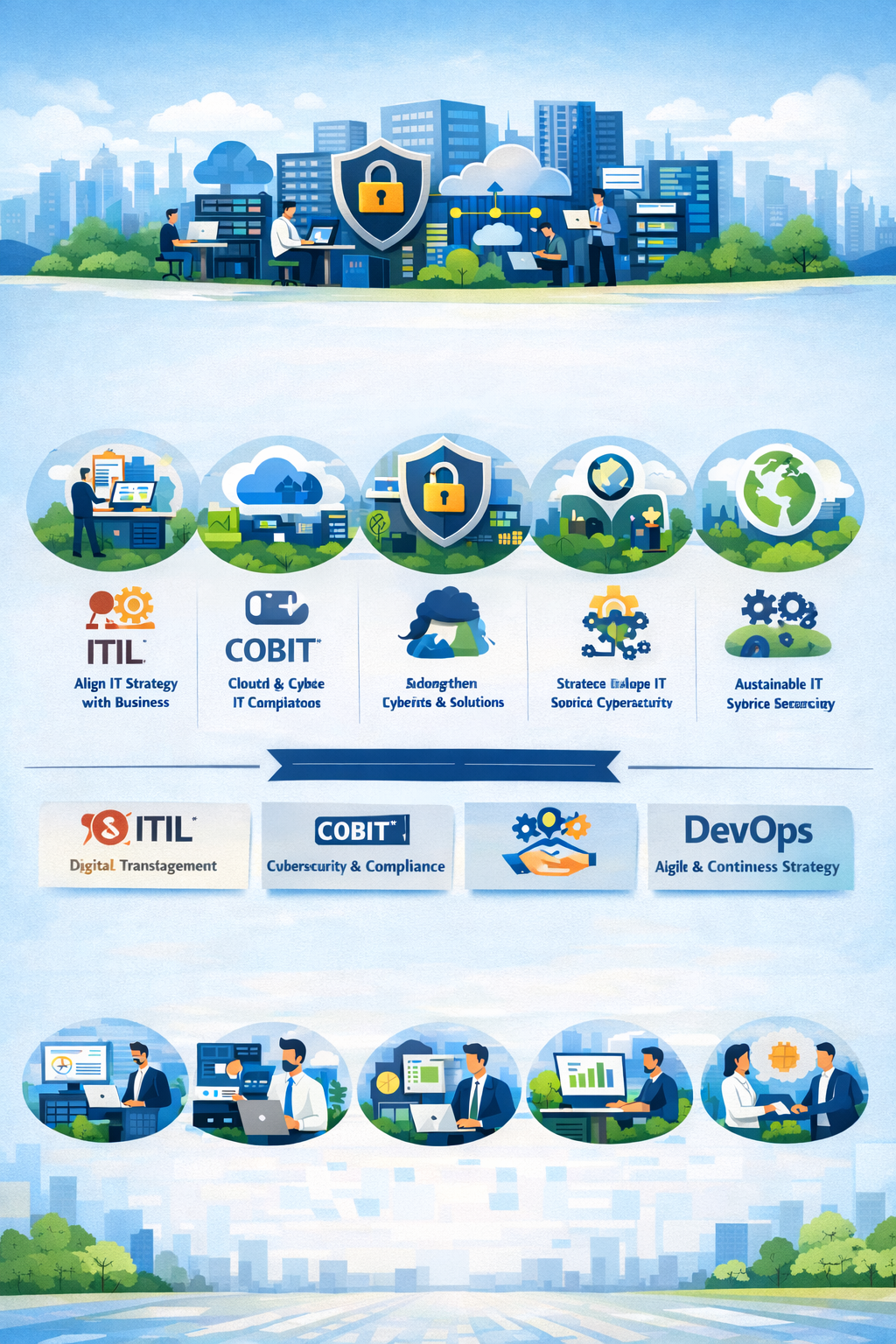
Choosing the right framework is critical for effective IT management. Let’s explore the strengths of ITIL, COBIT, and DevOps:
ITIL (Information Technology Infrastructure Library)
-
Focus: Service management
-
Strengths: Provides a structured approach to IT service delivery, ensuring customer satisfaction and operational efficiency.
-
Best for: Organizations prioritizing service quality, ITSM maturity, and SLA compliance.
COBIT (Control Objectives for Information and Related Technologies)
-
Focus: Governance and compliance
-
Strengths: Ensures IT processes align with business objectives, risk management, and regulatory standards.
-
Best for: Enterprises requiring auditability, accountability, and strong IT governance.
DevOps
-
Focus: Collaboration and continuous delivery
-
Strengths: Breaks down silos between development and operations, enabling faster releases, automation, and scalability.
-
Best for: Organizations adopting agile practices and rapid innovation cycles.
Which Should You Choose?
-
Use ITIL if service management and customer experience are top priorities.
-
Choose COBIT if governance, compliance, and strategic alignment are essential.
-
Implement DevOps if speed, collaboration, and automation are critical for success.
Many organizations adopt a hybrid approach, combining elements of all three frameworks to create a customized model that balances governance, agility, and service excellence.
The Role of a CIO in Modern Organizations
The Chief Information Officer (CIO) has evolved from a technology overseer into a strategic business leader. In modern organizations, the CIO’s role includes:
1. Driving Digital Transformation
CIOs lead digital transformation initiatives by introducing technologies such as AI, IoT, blockchain, and cloud-native platforms to reshape business processes.
2. Ensuring Cybersecurity and Compliance
With increasing cyber threats, CIOs play a vital role in implementing cyber resilience strategies, compliance frameworks, and disaster recovery plans.
3. Aligning IT with Business Strategy
Modern CIOs ensure that every technology decision supports business growth, cost efficiency, and competitive advantage.
4. Leading IT Talent Development
CIOs must build teams equipped with skills in AI, DevOps, cloud computing, and cybersecurity while fostering a culture of continuous learning.
5. Championing Innovation and Sustainability
The CIO now drives innovation by experimenting with emerging technologies and adopting sustainable IT practices that minimize environmental impact.
Conclusion
IT management is no longer a support function—it is a driving force behind business transformation and innovation. By adopting best practices, implementing effective governance frameworks, and leveraging the right methodologies, organizations can thrive in 2025 and beyond. The evolving role of the CIO further highlights how integral IT has become to business strategy, security, and growth.
For More Information Visit itmanagement4u!