The world of IT management is transforming faster than ever before. Between now and 2030, organizations will face new challenges and opportunities shaped by artificial intelligence, cloud-edge convergence, cybersecurity innovations, sustainable technologies, and advanced computing models. Businesses that adapt to these trends will not only survive but thrive in the hyper-connected digital economy.
In this guide, we’ll explore the future trends in IT management from 2025 to 2030, including how agentic AI, hybrid cloud strategies, quantum breakthroughs, and immersive technologies will shape the decade ahead.
Key IT Management Trends for 2025–2030
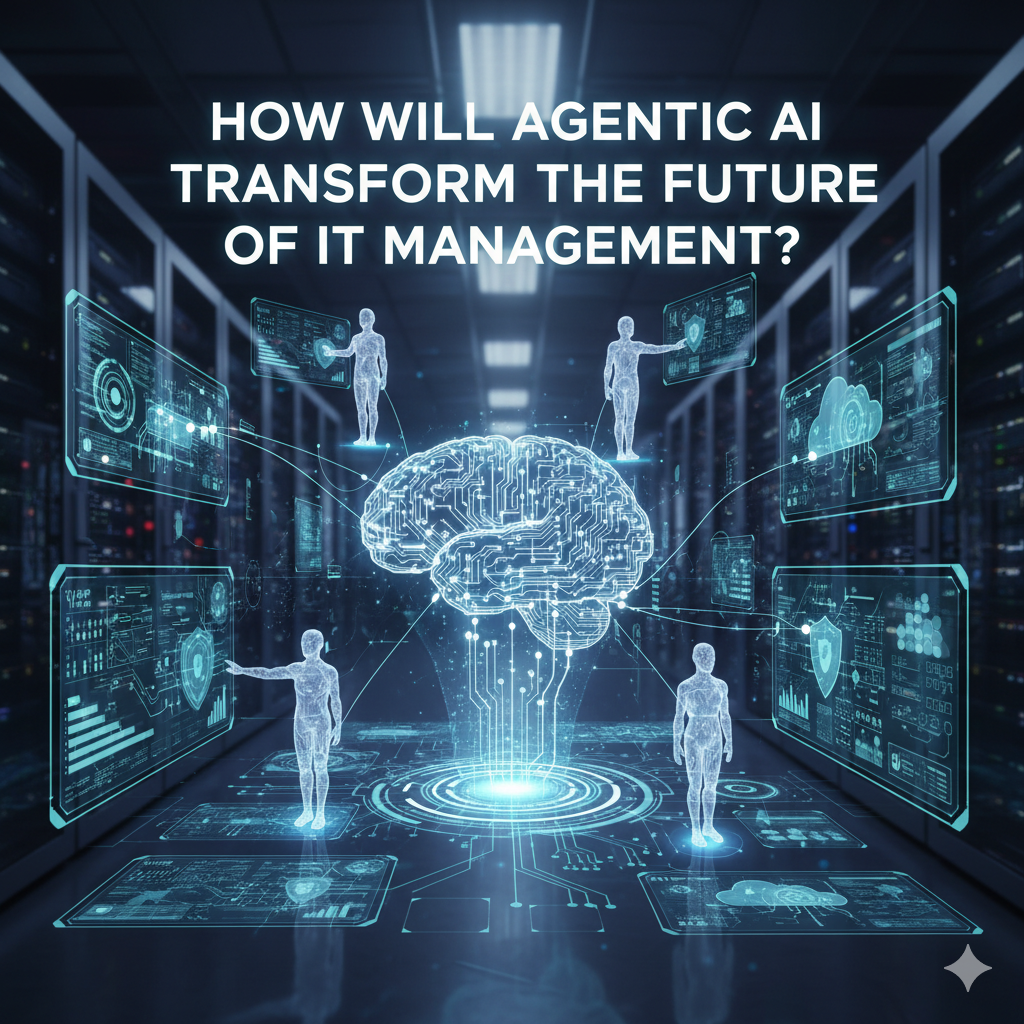
Agentic AI and Hyper-Automation
Artificial intelligence is no longer limited to chatbots or simple analytics. The rise of agentic AI will redefine IT management. These AI systems are capable of:
-
Making autonomous decisions with minimal human intervention.
-
Optimizing infrastructure by predicting failures and applying fixes instantly.
-
Automating repetitive tasks such as software deployment, patch management, and compliance reporting.
-
Acting as digital colleagues, capable of negotiating between systems and solving complex, multi-step problems.
By 2030, IT departments will rely on AI-driven autonomous infrastructure management, saving time, reducing errors, and freeing teams to focus on innovation.
Cloud-Edge Convergence
The next phase of cloud adoption isn’t about choosing a provider it’s about seamlessly connecting clouds and edges.
-
Hybrid and Multi-Cloud Strategies: Companies will leverage multiple providers (AWS, Azure, Google Cloud, private clouds) to balance performance, costs, and security.
-
Edge Computing Expansion: Data will increasingly be processed at the edge of networks closer to users, devices, and IoT endpoints reducing latency for applications like autonomous vehicles and smart factories.
-
Cloud-Edge Synergy: Together, hybrid clouds and edge computing will enable real-time decision-making, critical for industries like healthcare, logistics, and finance.
Cybersecurity Enhancements
As threats evolve, IT leaders must rethink cybersecurity strategies for the quantum era.
-
Post-Quantum Cryptography (PQC): Designed to protect sensitive data from quantum computer decryption, PQC will become standard for governments and enterprises.
-
Continuous Threat Exposure Management (CTEM): Security won’t be reactive anymore. Instead, AI-driven platforms will monitor vulnerabilities in real time, simulating potential attacks to predict risks before they occur.
-
Zero Trust Architecture: By 2030, Zero Trust will be embedded into every IT system, ensuring no user or device is automatically trusted.
Cybersecurity will shift from defense to proactive risk anticipation, using AI and predictive analytics to stay ahead of attackers.
Quantum Computing Revolution
Quantum computing remains in its infancy, but breakthroughs are expected between 2025 and 2030.
-
Supercharged Processing Power: Quantum machines will solve problems in seconds that classical computers couldn’t solve in centuries.
-
Practical Applications: From drug discovery and financial modeling to supply chain optimization and AI training, quantum computing will revolutionize industries.
-
Integration with Classical Systems: IT managers will oversee hybrid models where quantum systems support traditional data centers.
Organizations that prepare now investing in quantum readiness will have a competitive edge in the next decade.
Augmented and Virtual Reality (AR/VR)
Immersive technologies will move far beyond gaming. In IT management and business operations, AR/VR will play a central role in:
-
Training and Simulation: Virtual labs for IT professionals to test scenarios without real-world risks.
-
Collaboration: Remote teams will meet in virtual offices, sharing 3D data environments for decision-making.
-
Field Support: AR glasses guiding technicians through complex repairs in real-time.
By 2030, AR/VR will become as common in IT operations as video conferencing is today.
Sustainable Technology and Green IT
With growing pressure on businesses to reduce carbon footprints, sustainability will dominate IT management strategies.
-
Energy-Efficient Data Centers: New cooling technologies and renewable-powered infrastructure will cut emissions.
-
Circular IT Practices: Extending hardware lifecycles, recycling e-waste, and reducing unnecessary upgrades.
-
Sustainable Cloud: Providers will offer green cloud solutions certified for eco-efficiency.
Sustainability will no longer be optional it will be a key performance indicator for IT departments worldwide.
Internet of Things (IoT) Expansion
The spread of 5G and beyond will accelerate IoT adoption, connecting billions of devices across industries.
-
Smart Cities: IoT will manage traffic, energy grids, and public safety.
-
Healthcare IoT: Wearables and medical devices will enable real-time patient monitoring.
-
Industrial IoT (IIoT): Manufacturing and logistics will use IoT for predictive maintenance and supply chain visibility.
Coupled with AI and blockchain, IoT will provide secure, intelligent automation across ecosystems.
Digital Twins and Spatial Computing
Digital twins virtual replicas of physical systems will empower IT managers to predict outcomes before making real-world changes.
-
Infrastructure Simulation: IT systems can be stress-tested in a digital twin environment.
-
Spatial Computing: Users will interact with digital models in 3D space, revolutionizing design, engineering, and IT support.
-
Decision-Making: Real-time monitoring will allow managers to see problems before they happen.
By 2030, digital twins will be standard in industries from aerospace to healthcare.
AI Governance and Responsible Innovation
With AI taking center stage, governance frameworks will become essential.
-
AI Trust and Transparency: Regulations will demand explainable AI systems.
-
Bias Mitigation: IT managers will oversee platforms that ensure fair outcomes.
-
Ethical Innovation: Companies will be judged not just on performance but on how responsibly they use technology.
Responsible AI management will protect both companies and consumers, ensuring trust in digital systems.
Beyond 2025: Additional Emerging IT Trends
-
Robotics and Autonomous Systems: Automating physical processes in warehouses, hospitals, and IT hardware management.
-
Blockchain Integration: Providing transparency and security in financial systems, supply chains, and identity management.
-
Neurotechnology Interfaces: Brain-computer interfaces enabling new modes of human-computer interaction.
-
5G and 6G Connectivity: Faster, more reliable networks unlocking new IT innovations.
Preparing for the IT Future
The years 2025 to 2030 will bring a wave of transformation in IT management. To stay ahead, organizations must:
-
Invest in AI and automation platforms now.
-
Adopt hybrid cloud and edge strategies for agility and resilience.
-
Prioritize cybersecurity, including post-quantum preparedness.
-
Experiment with AR/VR and digital twins to unlock collaboration and simulation.
-
Commit to sustainability as a long-term strategy, not just compliance.
Conclusion: The Next Decade of IT Management
The future of IT management is a thrilling mix of automation, intelligence, sustainability, and immersive technology. Businesses that embrace these trends between 2025 and 2030 will be more secure, efficient, and innovative.
As we look forward, IT leaders must remember: the future is not about managing technology — it’s about managing change.
For More Information Visit itmanagement4u!