Introduction
The IT industry is moving at lightning speed. New tools, new threats, and new ways of working appear every year. If you’re an IT professional (or hoping to become one), you’ve probably noticed that keeping up can feel like chasing a moving train. The good news? Certifications can help you catch that train and even jump into the driver’s seat.
Certifications are more than just badges you add to your résumé. They prove that you have real, tested knowledge. Employers trust them, hiring managers look for them, and professionals who invest in them often see promotions, salary bumps, and fresh opportunities.
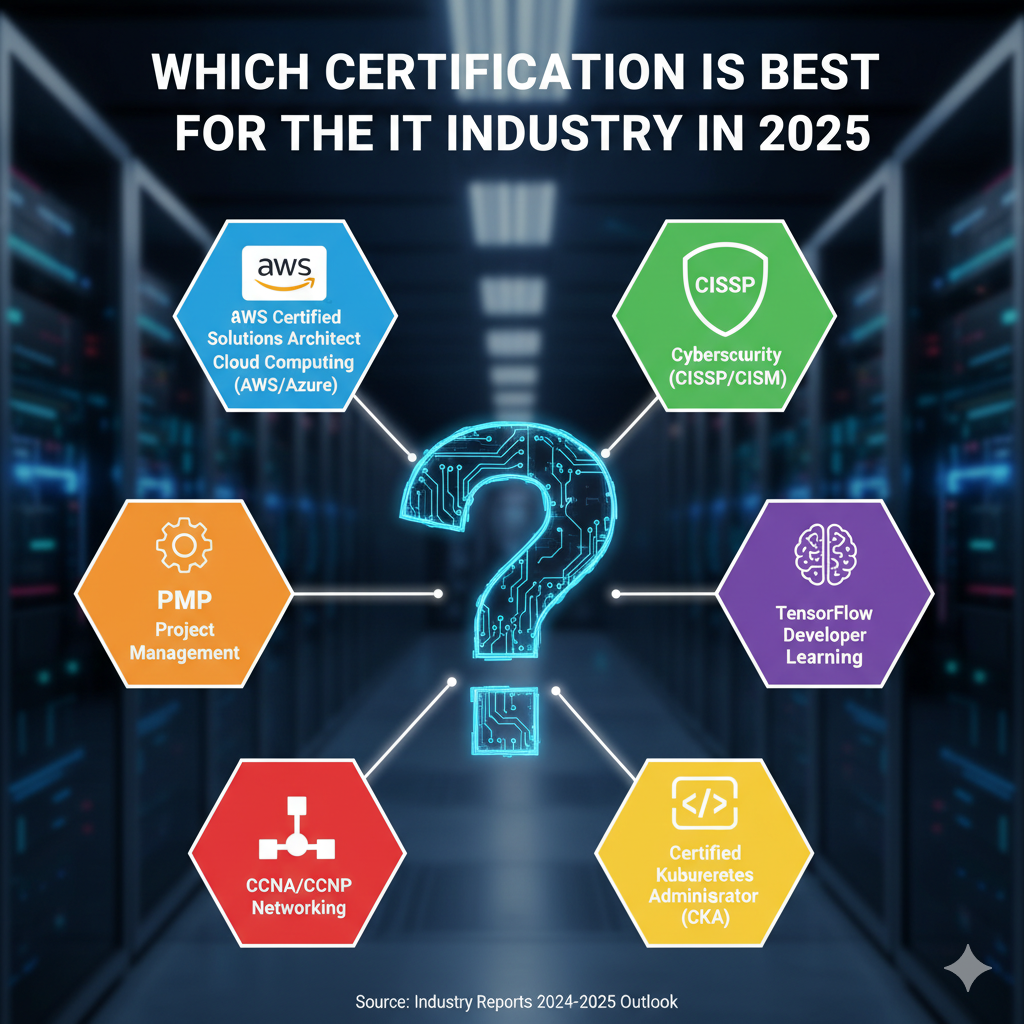
But here’s the million-dollar question: Which certification is best for the IT industry in 2025?
That’s what this guide will help you figure out. We’ll walk through:
-
Why certifications matter more than ever
-
The best entry-level certifications to start your career
-
Specialized certifications in cybersecurity, cloud, networking, and data
-
Top management-level certifications that open doors to leadership
-
Practical advice on choosing the right one for your goals
By the end, you’ll know which certification fits your career path—and why it can give you a serious edge in the evolving world of IT.
Why IT Certifications Matter
Let’s get something straight: you don’t need a certification to get into IT. Plenty of people start with internships, on-the-job training, or self-taught skills. But certifications do something special—they give you proof.
Think about it. Imagine two candidates apply for the same job:
-
Candidate A: “I know cloud computing. I’ve played around with AWS at home.”
-
Candidate B: “I’m an AWS Certified Solutions Architect.”
Who do you think gets the interview callback?
Certifications show you’re serious, disciplined, and tested against industry standards. In fact, certifications matter because they:
-
Prove real-world skills – Employers know you didn’t just “read a blog” but passed a tough exam.
-
Give you an edge – When everyone else has the same degree, certifications help you stand out.
-
Boost your salary – Studies consistently show certified IT pros earn more.
-
Open career doors – From cybersecurity to project management, certifications can be the ticket to roles you wouldn’t qualify for otherwise.
-
Keep you relevant – Technology changes fast. Certifications keep your knowledge up to date.
Here’s another bonus: many certifications are vendor-neutral, like CompTIA, meaning they apply across technologies. Others are vendor-specific (like AWS or Microsoft), which let you show deep expertise in a particular ecosystem. A balanced mix of both is often the smartest path.
Entry-Level IT Certifications to Kickstart Your Career
If you’re just starting in IT, the choices can feel overwhelming. Don’t worry—you don’t need to dive straight into advanced cloud or security certifications. Start small, build a foundation, and then level up. Here are some of the best beginner certifications in 2025:
1. CompTIA A+
-
What it covers: Hardware, operating systems, networking basics, and troubleshooting.
-
Why it matters: This is the gold standard for beginners. It’s recognized worldwide and often required for entry-level IT jobs.
-
Ideal roles: Help desk technician, IT support, junior systems admin.
2. AWS Certified Cloud Practitioner
-
What it covers: Cloud basics, AWS pricing, security, and deployment models.
-
Why it matters: Cloud is everywhere. This entry-level cert shows you understand how cloud platforms work.
-
Ideal roles: Entry-level cloud support, technical sales, IT generalists moving toward cloud.
3. Microsoft Certified: Azure Fundamentals (AZ-900)
-
What it covers: Microsoft’s cloud ecosystem, services, and security.
-
Why it matters: If your company uses Microsoft tools, this is a no-brainer. Azure is growing fast and rivals AWS.
-
Ideal roles: Beginner IT professionals in Microsoft-heavy environments.
4. Cisco Certified Network Associate (CCNA)
-
What it covers: IP addressing, routing, security basics, automation.
-
Why it matters: Networks are the backbone of IT. CCNA proves you know how they actually run.
-
Ideal roles: Network admin, systems engineer, junior security analyst.
👉 Takeaway: If you’re new, start with CompTIA A+ (general IT), then add a cloud cert (AWS or Azure) or networking cert (CCNA) depending on your interests.
Specialized IT Certifications for Career Growth
Once you’ve got your foundation, it’s time to specialize. Employers want people with targeted skills who can solve specific problems. Here are the hottest specialization tracks in 2025:
Cybersecurity Certifications
Cybersecurity is exploding in demand. With cyberattacks and data breaches making headlines every week, companies are desperate for skilled defenders.
-
CompTIA Security+ – Best entry-level security cert. Covers threats, risk, and cryptography.
-
CISSP (Certified Information Systems Security Professional) – The king of security certifications. For senior roles like security manager or CISO.
-
CEH (Certified Ethical Hacker) – Teaches penetration testing and hacking from the “bad guy’s” perspective.
Cloud Certifications
Cloud isn’t the future—it’s the present. Businesses are moving everything to AWS, Azure, and Google Cloud.
-
AWS Certified Solutions Architect – Associate – The most in-demand AWS cert. Focuses on designing scalable solutions.
-
Google Cloud Certified – Professional Cloud Architect – Perfect for Google Cloud specialists.
-
Microsoft Certified: Azure Solutions Architect Expert – Advanced Azure cert for architects and consultants.
Networking Certifications
Networking is evolving with automation and security at its core.
-
CCNP Enterprise – Builds on CCNA with enterprise-level networking, security, and troubleshooting.
Data & Analytics Certifications
Big data and AI are rewriting how businesses make decisions.
-
IBM Data Science Professional Certificate – Covers Python, machine learning, and big data.
-
Certified Data Scientist – A more advanced track for those deep in analytics.
Project Management Certifications
Technology projects need strong leadership. Enter project management certifications.
-
PMP (Project Management Professional) – Globally recognized for project planning, scheduling, and leadership.
-
Certified ScrumMaster (CSM) – For IT teams working with Agile and Scrum frameworks.
👉 Takeaway: If you want to specialize, cybersecurity and cloud are the biggest growth areas in 2025.
Top 5 IT Management Certification Tracks (2025)
Maybe you’re not just interested in “doing the work” but leading teams and shaping IT strategy. If that’s you, management certifications are the next level.
1. IT Service Management (ITSM)
-
Best For: IT managers, service delivery specialists.
-
Key Cert: ITIL® (Information Technology Infrastructure Library) – Aligns IT services with business goals.
2. Project Management
-
Best For: Project leads and IT managers.
-
Key Certs: PMP® (traditional projects), CSM (Agile projects).
3. Information Security Management
-
Best For: Security leaders and compliance officers.
-
Key Certs: CISSP® (governance & strategy), CISM® (compliance & risk management).
4. IT Governance
-
Best For: Professionals bridging IT and business leadership.
-
Key Cert: COBIT® – Ensures IT aligns with business strategies.
5. Cloud Computing Management
-
Best For: IT managers leading cloud migrations.
-
Key Certs: AWS Solutions Architect, Azure Solutions Architect Expert, Google Professional Cloud Architect.
👉 Takeaway: If leadership is your goal, ITIL, PMP, or CISSP are some of the strongest management certifications in 2025.
Which IT Certification Is Best in 2025?
So, back to the original question: Which certification is best?
The truth is, it depends on your goals. Here’s a quick breakdown:
-
For beginners: Start with CompTIA A+ or AWS Cloud Practitioner.
-
For cloud careers: Go with AWS Solutions Architect or Azure Solutions Architect Expert.
-
For security careers: Choose CompTIA Security+ early, then aim for CISSP once you’re experienced.
-
For management roles: ITIL and PMP remain top choices.
But if we had to pick the most in-demand certifications across the board in 2025, they’d be:
-
AWS Certified Solutions Architect – Associate (cloud)
-
CISSP (cybersecurity)
-
ITIL® (service management)
Why? Because cloud, cybersecurity, and IT service management are the three biggest drivers of IT growth right now.
How to Choose the Right Certification for You
Picking a certification can feel like ordering at a massive buffet. Everything looks good—but what will actually satisfy you?
Here’s a simple three-step process:
-
Define your career goal.
Do you want to be a hands-on techie, a cybersecurity expert, or an IT leader? -
Match the cert to the goal.
Don’t just pick what’s “hot.” Pick what gets you closer to your dream role. -
Plan for progression.
Certifications build on each other. For example:-
CompTIA A+ → CompTIA Security+ → CISSP.
-
AWS Cloud Practitioner → AWS Solutions Architect Associate → AWS Solutions Architect Professional.
-
👉 Remember: certifications are stepping stones, not finish lines.
Conclusion
The IT industry never sits still. Every year brings new technologies, new challenges, and new opportunities. Certifications are one of the smartest ways to keep your skills sharp, prove your expertise, and stay competitive in a crowded job market.
In 2025, the “best” IT certification depends on what you want out of your career. If you’re starting fresh, go with CompTIA A+ or an entry-level cloud cert. If you’re climbing higher, focus on cybersecurity, cloud architecture, or IT service management. And if leadership is your path, ITIL or PMP can set you apart.
Whatever you choose, the key is to keep learning. Technology won’t slow down, and neither should you.
For more resources and career insights, visit itmanagement4u.